Finding Faith, Building Friendship: Reflections from the Interfaith Leadership Summit
Finding Faith, Building Friendship: Reflections from the Interfaith Leadership Summit
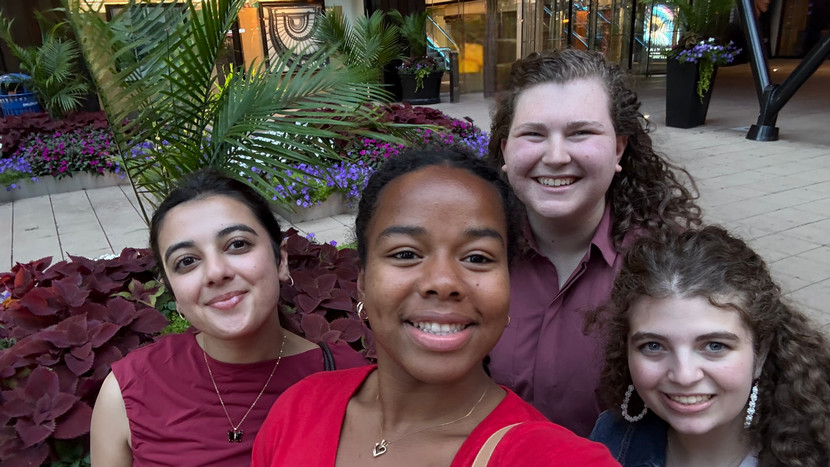
This article was collaboratively written by three students—Saige Beatman '26, Angelina Dickens '28, and Minahil Mobeen '28—and compiled by Multifaith Program Manager Olivia Rosenblum.
In early August, a small UR delegation traveled to Chicago for the annual Interfaith Leadership Summit hosted by Interfaith America. This three-day summit brought together over 100 universities and featured educational tracks exploring all things interfaith—from collaboration and dialogue to programming across faith traditions. Multifaith Program Manager Olivia Rosenblum invited three students—Saige Beatman '26, Angelina Dickens '28, and Minahil Mobeen '28—to attend the conference and then serve as multifaith leaders upon their return to campus.
While the three had crossed paths on campus, they hadn’t dived into multifaith as a group. So, when they first gathered in Chicago, the nerves were real. However, nerves quickly subsided as friendships developed and new bonds created space for trust and vulnerability.
For Angelina Dickens, the fast friendship began in the conference's small group sessions:
While in our small group sessions at the conference, I met a girl from a different university, who is very kind, funny, and Muslim. I got to meet her in an environment that promoted our similarities rather than our differences.
For Saige Beatman, the moment started even earlier—at a cozy breakfast spot before the conference sessions began:
As I explained my challah French toast to Angelina and Minahil, I noticed how exciting it became to discuss our cultures, traditions, dietary needs, and everything in between. At first, we tiptoed around our questions and added disclaimers like "not to be offensive, but…" However, by the end of the weekend, we had built meaningful trust with each other and with the other attendees. As I learned at the conference, we were able to have "brave" conversations.
Those "brave" conversations were vital to the shift that Minahil Mobeen experienced:
At each multifaith session, I noticed how open and respectful conversations about faith shifted the atmosphere from discomfort and unfamiliarity toward trust and vulnerability. My earlier hesitance to share faded as one mantra was repeated: "No single person is representative of an entire belief system; we are only representatives of our personal beliefs." As I accepted that lesson, I felt more comfortable being vulnerable and expressing the values Islam holds for me.
Bringing It Home
Upon returning to campus, all three students helped plan and facilitate multifaith conversations and the Chaplaincy’s new monthly program, Multifaith Mondays.
Saige's return to Richmond was particularly hectic as she welcomed the class of 2029 as an orientation advisor. Once the semester started and she had time to reflect, she shared:
While helping brainstorm a multifaith program where we each decorated a plate that reflected our backgrounds, I felt proud to see that kind of work taking shape on our own campus. As I prepare to graduate in May, I am constantly thinking about how multifaith work will show up in my future. I know that whatever I choose to do, both my Jewish identity and my desire to engage meaningfully with different backgrounds will show up (sometimes literally) at the table.
Minahil, who serves as an RA this year, echoed similar sentiments:
From the variety of "religious flavors" of ice cream to the distinctness of each decorated plate, the Multifaith Mondays captured the beauty in the diversity of faith on our campus. As I navigate my college journey, I will treasure the way that learning about other people's faith inspires me to become more confident in my own beliefs, helps me form more meaningful relationships, and challenges me to be a bit braver than I was the day before.
For Angelina, the experience deepened both her commitment to interfaith engagement and to her own Christian faith:
Taking the conference experiences back to campus, I am able to be more open to people who are different from me, promote inclusion, and connect with people who, at first glance, I might think I have nothing in common with. On campus, I help facilitate multifaith environments that encourage individuals of different faiths to meet and build relationships. This work is important to me because I have seen firsthand the impact it has had on my own life. Our differences should not keep us from one another; they should draw us toward each other—exemplifying the Lord's call to love our neighbor: "This is my commandment, that you love one another as I have loved you" (John 15:12).
What began as a nervous meeting in Chicago developed into lasting friendships and a shared commitment to building bridges across difference. These three students remind us that interfaith work isn't just about programming—it's about the brave conversations, vulnerable moments, and genuine connections that transform strangers into friends and curiosity into understanding.